USA Geography - Quiz Game
- 4.6
- Rating
- 500.00K
- Installs
- Free
- Price

 Analysis by App-foxy
I found USA Geography - Quiz Game most useful as a compact way to test what I already know about the United States rather than as a full geography course. Its subject range is broad: maps, flags, seals, capital cities, rivers, lakes, and counties all fit under one trivia-focused experience. That makes it easy to pick up for a few minutes, but it also means the app works best when you want recall practice, not long explanations or a guided lesson.
After spending time with it, my overall impression is positive. Atom Games Ent. has made a focused quiz game that can suit students, curious travelers, families, and anyone who enjoys identifying places and symbols. It is free to start, rated for Everyone, and available for devices running Android 5.0 or later. Its average rating is 4.6 from around 2.7 thousand ratings, and the game has passed 500 thousand installs, so it has clearly found a substantial audience.
How the quiz feels to read and navigate
The biggest strength for me is the clear subject focus. I do not have to sort through unrelated categories before reaching American geography questions. One moment I can be thinking about state capitals, and the next I can test myself on a flag, a seal, or a physical feature. That variety prevents the experience from becoming a simple capital-city drill.
You May Also Like

 Blood Strike: 2.5 Anniversary
Blood Strike’s Loadouts Turn Every Drop Into a Tactical Gamble
A close look at Blood Strike’s custom loadouts: how fast access to signature weapons reshapes its battle royale rhythm, rewards preparation, and narrows the gap between fights.

 Pandora - Music & Podcasts
Pandora’s Music Is Easy to Start, but Harder to Recover
Pandora’s strength is its low-effort path from a seed to a station. Its weak spot is how much confidence it asks you to place in connection, setup, and quiet recovery.

 8 Ball Pool
 Is Built on Rivalries, Rematches, and Routine
A close look at the rivalries, rematches, shared routines, and unanswered safety questions that turn a quick pool match into a persistent mobile community.

 Samsung Music
’s Quiet Strength Is Playing What You Already Own
Its reach comes less from spectacle than from dependable access to a personal library. That simplicity is both the app’s strongest retention engine and its ceiling.

 AccuWeather: Weather Radar
AccuWeather Review: A Quick, Clear Forecast for Everyday Decisions
For everyday plans, the best forecast is the one you can understand quickly. AccuWeather makes rain timing, radar, and local conditions easy to act on, with a few trade-offs.

 Hill Climb Racing
Why Hill Climb Racing Still Turns Crashes Into One More Run
A tiny car, a bumpy hill and one more upgrade: Hill Climb Racing keeps resurfacing because its simple chaos makes every near-miss feel personal.
More From Our News Desk
View All News


The visual topics also give the game a useful rhythm. Questions involving a map or emblem ask me to observe, while questions about capitals, counties, rivers, or lakes depend more on memory. Switching between those kinds of recognition makes the session feel less repetitive than a quiz built around one fact type.
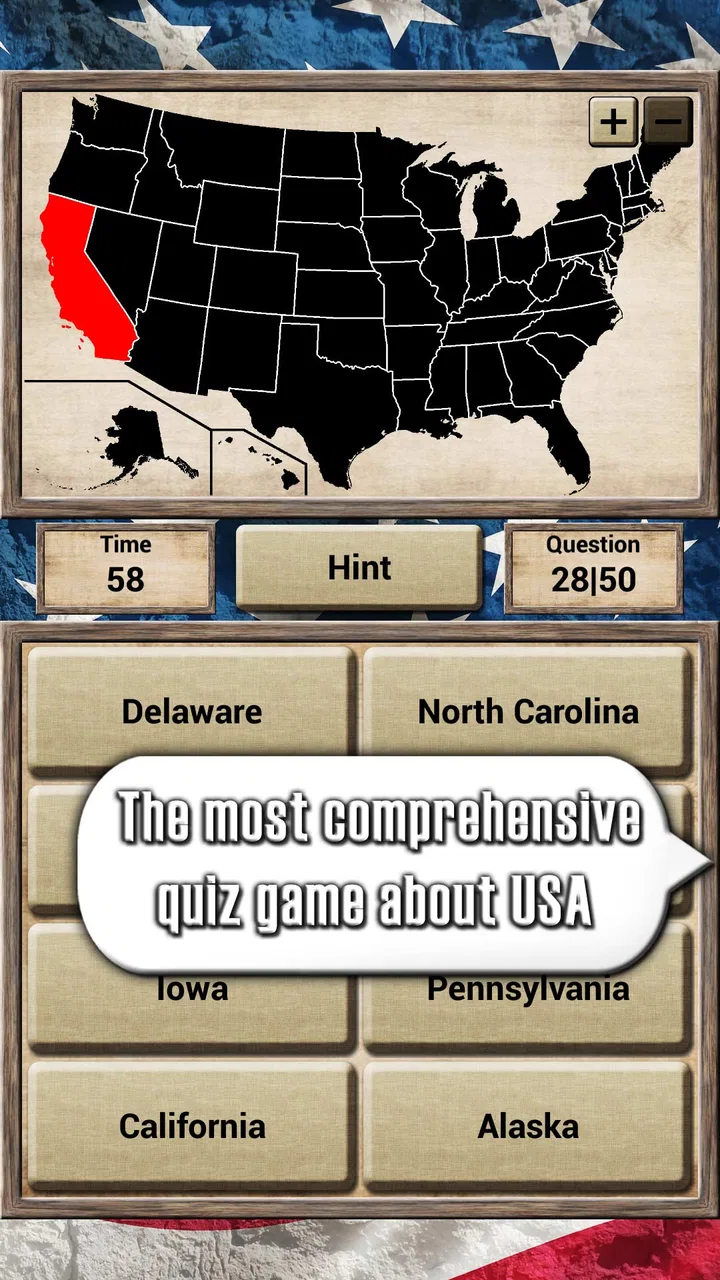
For readability, the most important practical point is that this is a visual trivia game. A player needs to distinguish labels, outlines, colors, and symbols, depending on the question. I found that a larger phone screen is more comfortable for map-based material than a small display, especially when I am trying to compare neighboring shapes or inspect a detailed image. On a tablet, the same content should be easier to view, although the game’s core appeal remains its quick-question format.
Navigation is also easier when I treat the app as a short-session tool. I can open it with a specific goal—review capitals, refresh state knowledge, or simply play a few rounds—and stop without needing to commit to a long campaign. That makes it practical for a study break or a waiting room. It is less suitable if I want a carefully sequenced curriculum that explains each topic from beginner to advanced.
The useful distinction is between testing and teaching. The game is strong at showing me whether I can recognize an answer under pressure. It is not the same as reading a geography guide, where every wrong answer would normally be followed by a detailed explanation, a map reference, and a chance to understand the underlying reason.
Why the subject mix matters
A generic state-capital quiz can become predictable after a few sessions. This game has more room to surprise me because American geography is not limited to capitals. A player who knows the major cities may still struggle with county names, state seals, or the locations of lakes and rivers. That unevenness is valuable: it reveals the difference between broad familiarity and genuine geographic knowledge.
I also like the possibility of using the categories as separate mental exercises. Flags and seals are primarily visual memory. Capital cities rely on direct recall. Maps test spatial recognition. Rivers, lakes, and counties require a more detailed sense of regional geography. If I repeatedly miss one type, that tells me exactly where my knowledge is thin, even if the game does not replace a formal study plan.
For a parent or teacher, this makes the app more flexible than a single-purpose quiz. A child can begin with recognizable flags and maps, while an older student can use county or physical-feature questions as a tougher review. Still, I would not assume that every player will find all categories equally accessible. Visual recognition and text recall place different demands on the user, and the experience naturally favors people who are comfortable with both.
Everyday ways I would use it
My favorite realistic use is a ten-minute review before a class or while traveling. I might play a short session on state capitals, notice that I am guessing too often, and then switch to flags or maps for a confidence-building round. That is more useful than mindlessly repeating one category because it combines practice with a quick check of what I actually remember.
It can also work well as a shared, informal activity. Two people can take turns answering questions and discuss why one state has a particular outline or which region contains a river or lake. Because the topics are familiar enough to start a conversation, the game can become a prompt for looking at a physical map afterward. In that situation, the app is not the entire lesson; it is the trigger that makes the lesson more active.
Another non-obvious use is diagnostic rather than competitive. I can keep track mentally of the kinds of mistakes I make: confusing neighboring states, recognizing a flag but forgetting the capital, or knowing a lake’s name without placing it correctly. That pattern helps me choose a better follow-up resource. If my problem is spatial, I need a map. If it is recall, flashcards may help more than another random quiz session.
Motor, visual, and sensory considerations
From an interaction standpoint, a trivia game is generally less demanding than a fast action game. I do not need rapid movement, complex combinations, or sustained physical control. That makes this type of geography practice a reasonable option for someone who prefers slower, deliberate interaction. I can pause mentally between questions and focus on the answer rather than coordinating several controls at once.
However, “simple” does not mean effortless for every player. Selecting an answer still requires accurate tapping, and map or image questions may be harder for people with limited fine-motor control if targets are close together or if the display is small. I would test the game on the intended device before recommending it for someone who has difficulty with precise touch input.
Visual access is even more central. Flags, seals, map outlines, and geographic shapes carry much of the information. A player with reduced vision, color-vision differences, or difficulty distinguishing small details may face a real disadvantage. I would not rely on the game alone for accessible geography study unless the player has already confirmed that the images and text are comfortable to interpret.
There is a practical workaround for some users: increase the device’s system text size or display scaling where the operating system allows it, hold the phone closer, and use a larger screen. Those adjustments may improve general legibility, but they cannot guarantee that every map, emblem, or color distinction will become clear. A screen reader or magnification tool may also behave differently depending on how the game presents its content, so this is something I would check directly rather than promise.
Hearing is less central than sight for this particular subject. The knowledge being tested is primarily visual or written, so a player does not need to depend on spoken instructions to understand the geographical material. That said, someone who prefers audio-based learning may find the experience less comfortable than a narrated lesson or podcast. The game’s format is built around looking and choosing, not listening and discussing.
For people sensitive to visual stimulation, short sessions are the safest approach. I would avoid treating it as background entertainment while multitasking. Looking carefully at maps and symbols requires attention, and playing while tired or in a visually busy environment can make mistakes feel like a display problem rather than a knowledge problem.
Access in different situations
The free entry point matters for casual use. I can try the game before deciding whether it belongs in my regular study routine, rather than committing immediately to a purchase. There are in-app purchases ranging from $1.99 to $44.99 per item, so I would review any purchase screen carefully and avoid assuming that every part of the experience is included without cost.
That pricing range also affects how I would recommend it to families. The game is rated Everyone, which makes it broadly appropriate in terms of stated age classification, but an adult should still supervise purchases on a shared device. The age rating tells me who the content is intended for; it does not remove the need to check whether the visual demands, question difficulty, and payment choices suit a particular child.
Its modest device requirement is another practical advantage. Support for Android 5.0 or later means it can be considered on older compatible Android hardware, which is useful for a spare family phone or a school device that is not new. I would still expect the physical screen quality and touch responsiveness to matter more than the operating-system requirement when judging comfort.
Because it is a short-form quiz, it fits moments when a full textbook is inconvenient: waiting for an appointment, taking a break between tasks, or reviewing before a test. I would not use it while walking, cycling, or driving. Maps and small visual details demand attention, and a geography game is not a safe substitute for awareness of the surrounding environment.
Where it falls short for inclusive learning
The main barrier is that the game appears to depend heavily on visual interpretation and touch selection. That is not a flaw in the idea of a geography quiz, but it limits who can use it comfortably without adjustments. Players who need strong text alternatives, high-contrast presentation, keyboard control, spoken feedback, or specialized navigation should verify compatibility on their own device before making it a primary learning tool.
Another limitation is the likely gap between an incorrect answer and real understanding. When I miss a county or confuse a river, I know that my recall failed, but I may still need a separate map or reference source to learn the correct context. This matters especially for students who need explanations, not just scores. The game can show me what to revisit, but it should not be mistaken for a complete geography curriculum.
The breadth of topics can also create an uneven difficulty curve. A familiar flag may feel approachable, while a county question may depend on knowledge that many casual players have never encountered. That variety is part of the appeal, yet it can frustrate someone who expects a smooth progression. I would recommend it more confidently to learners who enjoy being challenged than to players who need every question carefully scaffolded.
There is also a trade-off between convenience and depth. A quick quiz is easier to fit into daily life than a textbook, but it offers less room for regional stories, historical context, physical geography, and explanations of why a place matters. If the goal is to prepare for a detailed exam, I would pair the game with class notes, an atlas, or a structured study resource rather than relying on repeated guessing.
Players who dislike repetition may eventually want more variety in how they practice. The subject list is broad, but the basic activity remains answering geography questions. Someone looking for exploration, narrative progression, or a simulated journey across the country would probably prefer a different kind of educational game. This is a focused quiz, and its value comes from that focus.
Who should try it, and who should skip it
I would recommend it to a student who wants a low-pressure way to review American geography, especially when the student already has some classroom knowledge and needs retrieval practice. It is also a good fit for adults who enjoy trivia and want to discover whether their knowledge extends beyond famous cities and state capitals.
Families may enjoy using it together, provided that the device is comfortable for everyone and purchases are managed. The Everyone rating makes the subject matter broadly family-friendly, while the range of topics gives different ages a chance to contribute. A younger player might identify a flag, and an older player might handle a county or river question.
I would be more cautious about recommending it to someone who needs a fully accessible, text-first, audio-first, or explanation-heavy learning experience. I would also steer away users who want a story-driven geography adventure, detailed lessons, or a tool designed specifically around exam preparation. In those cases, an atlas, flashcard system, or structured educational course may be the better choice.
The developer, Atom Games Ent., has kept the concept recognizable and practical: learn through repeated questions about the country’s visual and geographic identity. The current version is 1.0.43, and the game’s continued presence among hundreds of thousands of installs suggests that the format has lasting appeal. Still, popularity does not change the central trade-off: it is a review companion, not a replacement for explanation.
My inclusive verdict
After considering how it works in different settings, I see this game as a useful and approachable geography quiz with a clear audience. It is free to begin, covers more than the usual capital-city list, and can turn a spare few minutes into meaningful recall practice. Its strongest qualities are the variety of American geography topics and the way it exposes gaps that I might otherwise overlook.
Its accessibility is more conditional. The low-complexity interaction helps people who prefer simple touch controls, but the reliance on maps, symbols, colors, and visual detail can create barriers for players with visual or motor needs. Device settings may improve comfort, yet I would personally test the experience before using it in a classroom, family setting, or formal study plan where everyone needs equal access.
I recommend it as a flexible supplement, not as the only way to learn USA geography. Use it to identify weak areas, challenge a friend, or make a short review session less dull. Then follow missed answers with a map, notes, or another source that explains the geography behind the question. With that approach, the game earns its place as a handy trivia companion while its limits remain clear.
FAQs for USA Geography - Quiz Game
01What is USA Geography - Quiz Game?
USA Geography - Quiz Game is an educational app designed to test and enhance your knowledge of United States geography. It features a variety of quizzes and challenges that cover states, capitals, landmarks, and more. The game is suitable for all ages, making it a fun way to learn about the US.
02How does the gameplay work?
The gameplay involves multiple-choice questions and interactive map-based challenges. Users can choose different difficulty levels and topics, such as identifying states on a map or matching capitals to their states. The game is timed, adding a layer of excitement and encouraging quick thinking and recall.
03Is the app suitable for children?
Yes, USA Geography - Quiz Game is suitable for children. It provides a fun and engaging way for kids to learn about US geography. The app includes child-friendly graphics and questions that are appropriate for younger audiences, making it an excellent educational tool for schools and homeschooling.
04Are there any in-app purchases or ads?
The app offers a free version with ads and optional in-app purchases to remove these ads or unlock additional content. Users can choose to purchase premium features, such as advanced quizzes or detailed geographic information, to enhance their learning experience without interruptions.
05Can the app be used offline?
Yes, USA Geography - Quiz Game can be used offline. Once downloaded, users can access all the quizzes and challenges without an internet connection. This feature makes it convenient for use in areas with limited connectivity or during travel, ensuring uninterrupted learning.
Pros
- Engaging way to learn U.S. geography.
- Variety of question formats keeps it interesting.
- Includes detailed explanations for answers.
- User-friendly interface and easy navigation.
- Offline mode available for on-the-go play.
Cons
- Limited updates may affect content freshness.
- Ads can be intrusive during gameplay.
- Some questions are too repetitive.
- In-app purchases can be costly.
- Graphics are somewhat basic and outdated.

USA Geography - Quiz Game
Gallery